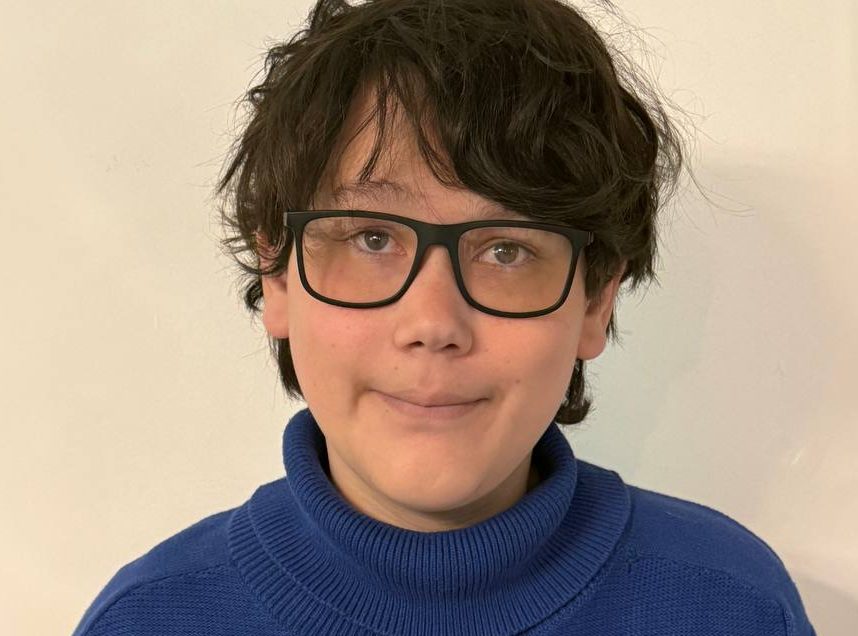
Meet Senna, a visually impaired creator who proves that true vision does not come from our eyes, but from our souls. As a digital artist, musician, photographer, and writer, Senna refuses to let physical limitations define his boundaries, showcasing a profound depth of talent that transcends sight.
The journey behind the canvas
Now 24 years old, Senna has built a creative life that demonstrates how health challenges should never deter someone from chasing their dreams. He was born with a craniopharyngioma, a rare, benign, and slow growing tumor that affects the endocrine system and the cranial nerves responsible for vision and hormonal function.
Doctors initially told his family that he would stop growing at a certain age because of the condition. However, Senna has continued to grow taller, defying medical expectations and offering his family a continuous reminder that miracles do happen.
Discovering a quiet sanctuary
Senna’s mother, Anna, first noticed his vision issues during a family trip to the Toronto Zoo when he was just two years old. After weeks of hospital visits, they ended up at a specialized children’s hospital where the tumor was diagnosed.
Medical professionals successfully conducted numerous procedures to ensure the tumor was no longer dangerous. Spending extended periods within the hospital walls ultimately unlocked Senna’s creative instincts, turning a challenging environment into the birthplace of his artistic journey.
Overcoming isolation and institutional barriers
Creativity runs deep in the family. “We are a family of artists,” says Anna, noting that the talent for creating is a shared trait. She adds that family members are incredibly fond of Senna’s specific gifts, often speaking about how unique his perspective is and noting that his style is entirely his own.
To further develop his skills, Senna enrolled in a digital art course. Unfortunately, he was unable to complete it because the program lacked adequate support and resources for students with visual impairments.
“The community we live in doesn’t have much support and resources for people with Senna’s condition,” Anna explains. This lack of support echoed during Senna’s school years, where he often felt isolated, believing that other children were closed off to him simply because he could not see them.
“I remember one day when I was dropping off Senna at school. Kids started waving at him and they wanted to reach out to him,” Anna recalls. The heartbreaking reality was that his peers wanted to interact with him, but Senna simply could not see their gestures, leading to a deep sense of loneliness. This isolation contributed to a battle with depression. Fortunately, Senna is in a much better place today and manages his mental health effectively with the help of antidepressants and his creative outlets.
A multi faceted creative process
When creating his digital art, Senna relies heavily on his iPad and Apple Pencil to draw expressive, unique digital comics that feature a distinct cartoon look and feel. His style has evolved beautifully as he has matured.
Because of his visual impairment, his creative process is collaborative. He relies on sighted assistance to bring his pieces to final execution, and his mother frequently helps guide him as he shapes his work.
Digital art is just one of his many channels, alongside photography, writing, and music. Each outlet expresses a different part of his soul, allowing him to process and communicate complex emotions, like anger or sadness, that he might otherwise struggle to express to people. While he has naturally grown away from music recently to focus on other mediums, he remains deeply passionate about exploring various genres within photography and writing.
Navigating art in the age of artificial intelligence
In a modern landscape increasingly dominated by automated tools, Senna holds a firm stance against the use of AI in art, viewing it as fundamentally inauthentic. “For me, that would be inauthentic because AI takes other people’s work and combines it to make graphics,” Senna explains. Because of this, he vows never to use AI tools, even for minor creative assistance.
Widespread AI usage makes audiences skeptical about the authenticity of genuine human art. However, Senna is confident that his work carries a distinct human touch, featuring specific lines and details that technology cannot replicate. His family recognizes this unique quality instantly. “Our family refers to certain art pieces by saying, ‘It’s a Senna,’” Anna notes. She emphasizes that some of his creations possess a depth that even sighted individuals cannot replicate.
Looking toward the future
Senna is currently writing a children’s picture book and is actively looking to get it published. He is designing the book to appeal broadly, ensuring the story and imagery cater beautifully to children of all age groups.
When asked what advice he would give to others facing similar hurdles, Senna offers a simple, powerful message to close his story: “Advice I would give to someone that is in my situation is: don’t stop. Don’t stop. And do not let your situation stop you from achieving what you want.”
Senna’s journey serves as a powerful reminder that physical challenges do not have to dictate your capacity to achieve your dreams, proving beautifully that art is indeed beyond sight.
Got a Story?
We want to hear from you. If there’s a story we should cover or someone we need to interview, email us at tbsnews@smellsdigital.com. To grow your brand with us, get in touch at ads@smellsdigital.com. Explore more at www.SmellsDigital.com.

Leave a Reply